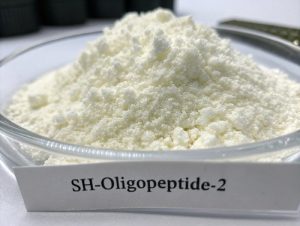
Google Suggest asks what sh-oligopeptide-1 is, then adds “(egf)” and “is egf” as if the nickname were the specification. sh-Oligopeptide-1 on this site is a white to off-white lyophilized powder, assay 99% or higher, soluble in water. The page also prints the common name epidermal growth factor, EGF. The label string you lock is the INCI. EGF is how the brief usually arrives. It is not a second SKU, and it is not a license to skip the powder-versus-stock math.
The split against unprefixed Oligopeptide-1 and against bFGF is Which INCI: sh-Oligopeptide-1, Oligopeptide-1, or bFGF.
What the INCI is describing
CosIng-style entries describe sh-Oligopeptide-1 as a single-chain recombinant human peptide produced by fermentation in E. coli. The starting gene is synthesized to match the human gene that codes for epidermal growth factor. The chain is described as a maximum of 53 amino acids, which may contain disulfide bonds and/or sugar. The listed function is skin conditioning. This product page does not print a CAS. Do not paste a catalog CAS onto the order until the COA shows that number.
Write sh-Oligopeptide-1 on the label line. Ask the COA for that INCI, the appearance, and the assay. A line that says only EGF can be this powder, the rh- name, or a blend. Those are not the same document. This site does not sell rh-Oligopeptide-1. Do not invent that URL.
Hair searches and “skin benefits” use the same powder. They do not create a second assay or a second pH window. A pregnancy question is a finished-product and clinical question. It does not change the stock math on this drum. Do not turn the page into a pregnancy or a side-effect review.
One percent of powder is not one percent of stock
The page says a typical use level for a standard stock solution is 1.0–10.0%, depending on the stock concentration and the market, and that the final peptide concentration is defined by the formulator. That sentence is about the stock you add. It is not an instruction to put 1–10% of the neat ≥99% powder into the kettle.
| What you weigh | What 1% means | Peptide that lands in 100 kg |
|---|---|---|
| Neat lyophilized powder, ≥99% | 1% of the powder as supplied | About 1 kg of powder, on the order of 10,000 ppm if the assay is real |
| A stock you made at 1,000 ppm peptide (0.1%) | 1% of that stock | About 10 ppm peptide |
| The same 1,000 ppm stock | 10% of that stock, the top of the page’s stock band | About 100 ppm peptide |
| “1% EGF” with no basis | Unknown | The sample request has to stop |
Build the stock in water or a suitable buffer, then add a stated percent of that stock at cool-down. Write both numbers: the stock concentration and the percent of stock in the formula. A bench that “adds 1% because the page says 1–10%” and scoops the dry vial has charged a different product level than a bench that adds 1% of a dilute stock.
A 10 g bench makes the same point without a 100 kg scare. If the stock is 1,000 ppm peptide, 1% of stock in 10 g of formula is 0.1 g of stock and 0.0001 g of peptide, which is 10 ppm. Scooping 1% of the neat powder into that same 10 g is 0.1 g of lyophilized powder. That is the mistake the suggest list creates when it treats EGF as a normal active at “about a percent.” Keep the vial for the stock. Do not weigh the formula percent out of the dry powder unless the TDS says the percent is as supplied peptide, and then use the ppm or percent that TDS prints.
The dry powder still has to be fully dissolved in the stock before that stock is called 1,000 ppm. Undissolved flakes mean the ppm you calculated is not the ppm in the liquid. Gentle stirring, no foam. If the stock is cloudy, stop and read the solubility line again: this page says soluble in water, not in oil. An oil-phase charge is the wrong phase.
Some published market rules cap finished EGF-named cosmetics near 0.001%, which is 10 ppm. That cap is not this page’s weighing instruction. If you must meet a cap, calculate it from the stock you actually made. Do not assume 1% of this powder is 10 ppm. It is not.
Water phase, pH, and what the powder will not survive
Reconstitute the lyophilized powder in sterile or deionized water or a suitable buffer. Add it to the water phase on cool-down, below about 40°C, with gentle stirring. Avoid foaming and high shear. The page lists stability in aqueous solution at about pH 5.0–6.5. Outside that window, do not expect the TDS to call the lot stable just because the dry powder assayed at 99%.
The same page says the material is sensitive to proteases, extreme pH, and heat. Keep it out of strong acids, strong alkalis, oxidizing systems, and formulas that already rely on a protease. A preservative system is still required for the finished product. This peptide is not the preservative.
sh-Oligopeptide-2 and Sodium Hyaluronate are named on the page as optional partners. Each has its own INCI and its own COA. Quote them only when the formula already names them. Hyaluronate does not replace the peptide assay. The second oligopeptide does not replace this one.
What the COA has to repeat
Match the PDF to the vial before you calculate ppm. The INCI line should read sh-Oligopeptide-1, not EGF alone and not a polypeptide name. Appearance should be a white to off-white lyophilized powder. Assay should meet the 99% line, and the method should say whether that percent is the peptide. Solubility in water is the stock check. If your file needs a CAS, the COA has to print it. This product page does not, so a CAS copied from a trade sheet is not confirmed until that PDF shows it.
Storage temperature is a TDS line. The page says the material is heat-sensitive. It does not print a freezer set-point. Follow the TDS for the unopened vial. Do not invent −20°C because another catalog uses it, and do not leave a reconstituted stock on a warm bench because the dry powder was stable.
What to send before the first sample ships
- INCI sh-Oligopeptide-1, not “EGF” alone
- Lyophilized powder, assay 99% or higher
- The stock concentration you will make, and the percent of that stock in the formula
- Target pH inside 5.0–6.5, and addition below about 40°C
- A note if the chassis contains a protease, a strong acid, or a high-heat step
- Bench-sample size, plus COA, SDS, and TDS
Batch documents and a sample are on the product page. Match the sample COA to the INCI and the assay, then scale the stock, not a guessed percent of neat powder. A line that names sh-Oligopeptide-1 and the stock basis usually returns documents. A line that says only “add 1% EGF” usually returns a question about 1% of what.