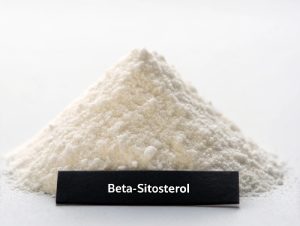
Google Suggest treats beta-sitosterol as a capsule: how much to take, prostate, BPH, cholesterol, which brand. Beta-Sitosterol on this site is a white to off-white crystalline powder, GC assay 98% or higher, CAS 83-46-5, from vegetable-oil distillate. It is insoluble in water. The suggested cosmetic charge is 0.5–2.0% in the oil phase. A supplement milligram is not that percent.
The blend that prints the same CAS is Beta-Sitosterol and Phytosterols Share CAS 83-46-5.
What the powder is
CosIng-style entries list Beta-Sitosterol, CAS 83-46-5, EC 201-480-6, as stigmast-5-en-3-ol, with functions that include emulsion stabilising, skin conditioning, fragrance, and light stabilizer. The product page prints the INCI, the same CAS, the chemical name 22,23-dihydrostigmasterol, and a melting point of about 136–140°C. Write Beta-Sitosterol and CAS 83-46-5 on the COA request. The page also offers cosmetic grade and pharmaceutical grade. Name cosmetic unless the file is actually a drug ingredient.
“Is it a steroid?” The molecule is a plant sterol. It is not a corticosteroid drug and not a prescription. That sentence does not make an oral cholesterol dose into a cream percent. Hair-loss dosages on the same suggest list are supplement questions. The page mentions scalp formulas as a possible use. It does not print a hair-growth claim or a milligram-per-day instruction. If the brief is a scalp tonic, you still weigh the powder in the oil or ester phase at a stated percent.
Foods that contain sitosterol are not this isolate. The source line is vegetable-oil distillate, soybean or pine on this page. Ask the COA which botanical the lot used if the allergen or origin file needs it. Do not replace the 98% assay with “natural, from plants.”
The percent is of the powder in the formula
| What people copy | What this page means | On 100 kg of cream |
|---|---|---|
| 0.5–2.0% | Of this ≥98% powder, as supplied | About 0.5–2 kg in the oil phase |
| “500 mg a day” from a capsule | An oral dose | Not a kettle percent. Do not divide 500 mg into a jar and call it 0.5% |
| 0.1–5% from the phytosterols page | A different SKU, even with CAS 83-46-5 | See the comparison article |
| 0.5% cholesterol | Cholesterol, CAS 57-88-5 | A different sterol and a different melting point |
A 200 g bench at 1% is 2 g of this powder, melted into the oil, not stirred into cold water. The powder will not dissolve in the water phase. Insoluble means grains if you add it there. Recrystallized grains after a sloppy cool-down are a process failure, not a low assay.
Scale the same way on a production batch. At 50 kg, 0.5% is 250 g of the ≥98% powder, 1% is 500 g, and 2% is 1 kg. All three sit in the oil phase at about 80–90°C. None of them is a capsule count. If purchasing sends 1 kg because the brief said “the high end,” confirm that 2% is what the formula wanted. The top of the band is a heavier sterol charge and a higher chance of crystals if the melt is incomplete. The low end is still this isolate. Do not “save” a failed melt by cutting the INCI to a cheaper sterol blend.
Oil phase, heat, and the ratio the page prints
Dissolve it in the hot oil phase, typically about 80–90°C, or in a high-polarity ester, so it stays dissolved. The page names octyldodecanol as an example ester. pH stability is listed at about 3–9. That does not move the powder into the water phase.
The page’s barrier note is a 3:1:1 molar ratio of Ceramide NP to this Beta-Sitosterol to free fatty acids. Stearic Acid is the fatty acid the same specification points at for that complex. Molar ratio is not three equal weight percents. Three kilograms of each is not 3:1:1. Ask the formulator which gram weights match that molar line before you lock the batch ticket. The cholesterol page prints its own ratios with ceramide and stearic acid. Do not paste those numbers onto this sitosterol line.
What a bad melt looks like
The powder has to disappear in the hot oil or the ester. If you see crystals after the emulsion cools, the usual checks are: was the oil hot enough, was the powder fully dissolved before the water went in, and did the cool-down crash it out. Those crystals are still beta-sitosterol if the COA said 98%. They are not a reason to switch the INCI to phytosterols or to cholesterol. They are a reason to remelt. Adding the powder to a cold water phase will leave the same grains for a different reason: the page says insoluble in water.
Cosmetic grade and pharmaceutical grade are both printed. A pharmaceutical COA can show a high GC number and still be the wrong grade for a cosmetic file. Write the grade next to ≥98%. Soybean versus pine is the origin line. If soybean is an allergen flag for the finished product, ask the lot before the oil phase is made.
A capsule that says 300 mg or 500 mg beta-sitosterol is a daily oral count. It does not tell you to put 300 mg into a 50 g jar and call the formula done. 300 mg in 50 g is 0.6%, which sits inside 0.5–2% only by arithmetic. It is still an accident if nobody wrote “0.6% powder in the oil phase.” Do the percent on purpose. Leave the prostate dose on the supplement label.
What to send before the first sample ships
- INCI Beta-Sitosterol, CAS 83-46-5
- Cosmetic grade unless you name pharmaceutical grade
- Powder, GC 98% or higher
- Use 0.5–2% as supplied, in the oil phase, with the melt temperature you need confirmed
- Botanical source if the file needs soybean versus pine
- A note if Ceramide NP and a fatty acid are on the same order
- COA, SDS, TDS, bench-sample size
Batch documents and a sample are on the product page. Match the sample to the CAS and the 98% assay, then scale in oil. A line that names the isolate and the oil-phase percent usually returns documents. A line that says only “beta-sitosterol for the prostate” usually returns a question about which grade.