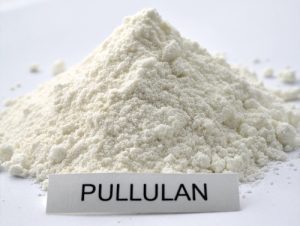
Google Suggest splits “what is pullulan powder” from “what are pullulan capsules.” Those are different goods. Pullulan on this site is a white to off-white, odorless fine powder, INCI Pullulan, CAS 9057-02-7, purity 99% or higher. It is a fermentation polysaccharide, formula (C6H10O5)n. It is not an empty capsule shell, and it is not a thickener you can swap for Xanthan Gum by the same percent.
What the powder does once it is in a serum or a primer is Pullulan in Skincare Is a Film, Not a Xanthan Charge.
What the INCI is printing
CosIng-style entries describe Pullulan as a polysaccharide produced from starch by Aureobasidium pullulans, CAS 9057-02-7, EC 232-945-1, CosIng reference 58766. Declared functions are binding and film forming. The product page prints the same INCI and the same CAS, and it sells the material as a cosmetic powder. Write Pullulan on the label. Ask the COA for that INCI, that CAS, and the assay. Do not accept a capsule-grade sheet that never states the cosmetic powder specification.
“What is it made of?” is the fermentation step, not a plant extract with a different Latin name. The organism in the CosIng description is Aureobasidium pullulans. The polymer is a glucose polysaccharide. Trade descriptions call the repeating piece maltotriose joined by α-1,6 links. That structure is why the powder dissolves in water and dries to a clear film. It is not a reason to treat the lot as starch, as a gum, or as an enzyme.
Pullulanase, which also appears in the suggest list, is an enzyme that splits the polymer. It is not this powder. Do not order an enzyme because the names share a root. Do not put “Aureobasidium” on the purchase order as if it were a second INCI. The organism is the production route. The name you lock is Pullulan.
Capsules are a different object
People Also Ask spends most of the first circle on eating pullulan: is it good for you, is it safe to consume, is it vegan, is it natural. Google Suggest adds capsule shells, gluten-free capsules, and “are pullulan capsules safe.” A capsule shell can be made from pullulan. That shell is a molded dosage form with its own moisture, weight, and dissolution spec. It is not a kilogram of cosmetic fine powder, and it is not weighed at 1–5% into a serum.
If the project is empty capsules, say so. This page will not answer shell weight, capsule size, or vegetarian-capsule certifications. A size 0 shell might weigh about a tenth of a gram. That piece weight is a packaging count. It is not 1% of a 100 kg cream, and it is not a purity assay. If the project is a leave-on or a color cosmetic, order the powder and ignore the capsule COA.
Vegan and gluten questions on a capsule listing do not transfer to this drum unless the cosmetic COA prints them. Ask for the lines you will file. Do not invent them from a supplement catalog. A food-additive sheet for oral films can share the trivial name and still omit the cosmetic powder specification. Keep that sheet in the food file.
Safety questions stop at the powder specification
“Pullulan dangers” and “pullulan side effects” sit on the same suggest list. For this cosmetic powder, the check is the assay and the use window, not a toxicology essay. The page specifies purity 99% or higher, a fine odorless powder, and a suggested use of 1.0% to 5.0% when a tightening film is the point of the charge. pH stability on the page is about 3 to 9. Match heavy metals, microbiology, and loss on drying to the COA you request. An oral “is it safe to consume” article does not replace that COA, and it does not raise or lower the 1–5% band.
Weigh this powder, not a shell
| What you think you are buying | What this page is | How 1–5% reads |
|---|---|---|
| Fine powder, ≥99% | This product | 1.0–5.0% of the powder as supplied, for a film you can feel |
| Empty pullulan capsules | Not this SKU | A shell has a piece weight. It is not “3% pullulan” in a cream |
| A 10% solution from another catalog | Different math | 3% of that solution is about 0.3% polymer if the solution assay is real |
| Xanthan or another gum | Different INCI | Do not copy a gum’s 0.2–0.5% thickener charge onto this film former, or the reverse |
A 100 kg batch at 2% of this powder puts about 2 kg of pullulan in the water phase. A 100 kg batch at 5% puts about 5 kg. That top end is what the page associates with a perceptible film. It is a large charge next to a typical gum. Write the percent next to “powder, as supplied.”
| Batch | What the sheet says | Powder on the scale |
|---|---|---|
| 100 kg | 1.0% of this ≥99% powder | About 1.0 kg |
| 100 kg | 3.0% of this powder | About 3.0 kg |
| 100 kg | 3.0% of a 10% solution from another catalog | About 0.3 kg of polymer if that solution assay is real, which is under the film band on this page |
| 200 g bench | 2.0% of this powder | 4 g |
| Any size | “3% pullulan” with no form | Stop. Powder, solution, and capsule shells are three different scales |
A supplier who quotes a liquid cut is not wrong to sell a liquid. They are wrong only if you copy this page’s 1–5% onto that liquid, or copy their liquid percent onto this powder. Say the form in the first email. If you truly need a predissolved grade, ask whether this plant will make it. Do not assume the 99% drum will be diluted for you.
Water, shear, and pH
The powder is soluble in water and forms a clear, viscous solution. “Viscous” here is not permission to treat it as the chassis thickener. The page says to add it to the water phase under high shear so it hydrates and does not clump. Lump-free hydration is the process check. If the first bench sample fisheyes, the usual fix is dispersion, not a new INCI.
The page lists thermal and light stability and a pH window of about 3 to 9. Confirm both on the TDS of the lot. A stable powder can still grain if it is dumped onto the surface of a cold, thick gel without shear.
On the COA, match the lines that decide the drum, not a capsule slogan. Appearance should read as a white to off-white fine powder. Assay should meet the 99% line you wrote, and the method should say what the percent is counting. Solubility in water is the process check: a clear solution, not a suspension of hulls. pH of a stated solution belongs on the TDS if your chassis sits near 3 or near 9. Microbiology and heavy metals are batch lines. Ask for them when your file requires them. Do not replace those lines with “natural” or “safe to consume.”
A practical dispersion note for the first bench: wet the powder into a portion of the water under high shear until no dry specks remain, then bring in the rest of the water. Several percent of a fine polysaccharide will sit on the surface if you tip the bag into a cold, already viscous phase. Grains at that point are undispersed powder. They are not a failed CAS.
What to send before the first sample ships
Put these lines in the message:
- INCI Pullulan, not a capsule shell and not Xanthan Gum
- CAS 9057-02-7
- Form: white to off-white fine powder, purity 99% or higher
- Use window 1–5% as supplied, and the percent you will actually weigh
- Water-phase, high-shear addition
- Finished pH if you need the 3–9 note confirmed
- Bench-sample size, plus COA, SDS, and TDS
Batch documents and a sample are on the product page. Match the sample COA to the INCI and the assay, then scale. A line that names Pullulan powder and the film percent usually returns documents. A line that says only “pullulan capsules, the safe ones” usually returns a question about which form.