
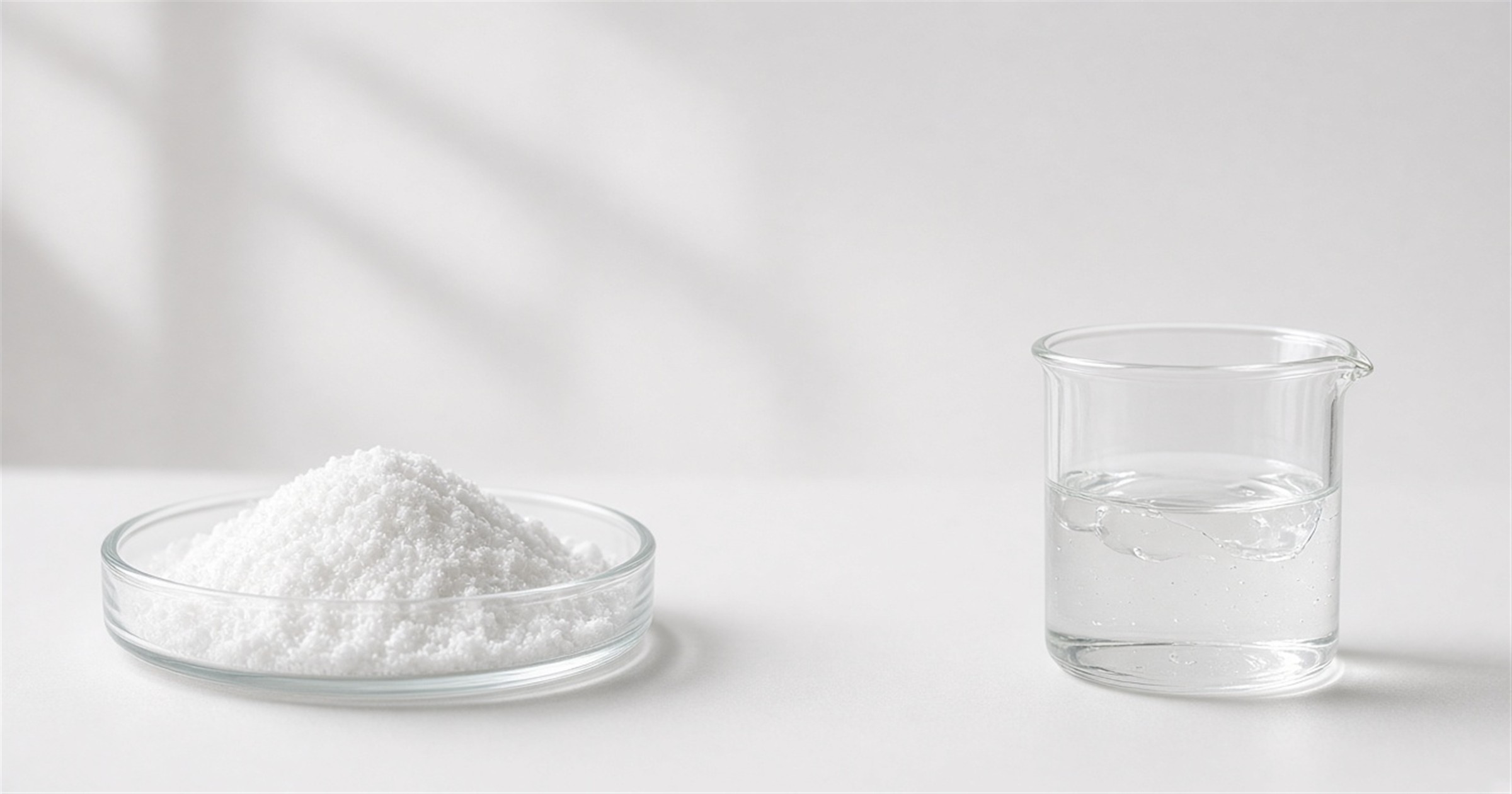
People Also Ask puts a hyaluronic-acid comparison on the ectoine graph. Google Suggest puts the phrase “sodium hyaluronate ectoine” beside it. Neither line is a ranking. Ectoine is a crystalline solute, CAS 96702-03-3. Sodium Hyaluronate is a polysaccharide salt, CAS 9067-32-7. Hyaluronic Acid is the acid form, CAS 9004-61-9, and this site already says the salt is the form most cosmetic kettles actually weigh.
“Is ectoine better than hyaluronic acid?” does not close a purchase. A serum can carry both. A serum that names only one still needs that INCI on the COA. The powder gate for ectoine is Ectoine Powder: Lock INCI Ectoin and the 99% Assay. The sugar gate is Trehalose vs Ectoine: Two CAS Lines and Two Percents.
Three names, three CAS lines
| Ectoine | Sodium Hyaluronate | Hyaluronic Acid | |
|---|---|---|---|
| INCI | Ectoin | Sodium Hyaluronate | Hyaluronic Acid |
| CAS on this site | 96702-03-3 | 9067-32-7 | 9004-61-9 |
| What you are holding | Small molecule, MW 142.16 | Polymer salt, molecular weight is a range | Polymer acid; the page says the salt is the usual cosmetic form |
| Form here | White crystalline powder, HPLC ≥99% | White powder, ≥95%, makes a viscous gel | White fibrous or granular powder, ≥95%; slower to dissolve than the salt |
| Suggested use on that page | 0.3–2.0% of the ectoine powder | 0.1–2.0% of the hyaluronate powder | The page points you to the salt for most development |
| What the percent is doing | Solute charge | Polymer charge; high molecular weight also thickens | Not a silent substitute for the salt |
A label that reads “sodium hyaluronate, ectoine” is two ingredients in one formula. It is not one blend SKU on this site. Order both pages if the brief names both. Do not ask the ectoine drum to arrive as a gel, and do not ask the hyaluronate drum to meet an HPLC ectoine assay.
“Better than” is the wrong column
Hyaluronic acid and its salt bind water as polymers. Ectoine is sold here as a compatible solute that stays dissolved across a wide pH. One can sit beside the other. Replacing 1% sodium hyaluronate with 1% ectoine changes both the water-binding polymer and the texture. The hyaluronate page warns that the powder needs slow dispersion or it fisheyes. Ectoine at the same nominal percent dissolves as a small molecule and will not build that gel.
The reverse swap fails the other way. A chassis that asked for 0.5% ectoine does not get that solute because you added 0.5% hyaluronate. The INCI list will show the polymer. The assay the buyer asked for will be missing.
If the brief says “HA” only, this site still splits the acid and the salt. The hyaluronic acid page states that cosmetic work usually weighs sodium hyaluronate. Lock that salt when that is what you will dissolve. Do not use the acid CAS on a salt COA.
Percents do not travel
| Charge you copy | Onto | Result |
|---|---|---|
| 0.1–2% from the hyaluronate page | Ectoine powder | You may under-dose ectoine relative to its 0.3–2% window, or you may be fine only if the number was already inside both bands. Write the INCI next to the number |
| 0.3–2% from the ectoine page | Sodium hyaluronate | The top of that band is still inside the hyaluronate page’s 2% cap, but you have not added ectoine |
| 1% “hydration complex” | One drum | The other INCI is absent |
Molecular weight belongs on the hyaluronate line only. That page sells a range from high molecular weight above 1.5 million daltons down to oligomers under 10,000 daltons, with medium and low bands in between. Ectoine does not have that range. Its molecular weight on this page is 142.16, one small molecule, not a polymer grade. Do not ask an ectoine COA for “low molecular weight.” Do not leave the hyaluronate molecular weight blank if the texture depends on it.
Both charges in one water phase
Hydrate the polymer first. The sodium hyaluronate page says to disperse the powder slowly, or to slurry it with a polyol, so it does not fisheye. Ectoine dissolves as a crystalline solute and will not fix a clump of undissolved hyaluronate. Add the ectoine after the gel is clear, in the water phase. The ectoine page still allows addition at any stage and often prefers below 40°C for a cold process. If the hyaluronate was hydrated hot, confirm on the ectoine TDS whether that lot should wait for cool-down. Do not dump both powders onto the surface of a finished cream and call it dispersed.
| 100 kg batch | Powder on the scale | What that percent is |
|---|---|---|
| 0.3% sodium hyaluronate | About 300 g of the polymer salt | A texture and water-binding charge. Name the molecular-weight band |
| 1.0% ectoine powder | About 1.0 kg of the crystalline solute | Inside the 0.3–2% ectoine window. Not a substitute for the 300 g above |
| 0.3% of “the hydration one” | One of those two, not both | The other INCI is still unordered |
A label that says hyaluronic acid while the kettle weighs sodium hyaluronate is the acid-versus-salt choice on this site, not an ectoine choice. The acid page, CAS 9004-61-9, says most cosmetic development should weigh the salt, CAS 9067-32-7, because the salt dissolves more readily. Write the salt INCI when that is the drum. Write Ectoin on its own line when the formula also asks for the solute. Three names on one marketing slide are still up to three COAs.
What to send when the formula names both
Use two blocks in the same message.
Ectoine block:
- INCI Ectoin, CAS 96702-03-3
- Crystalline powder, HPLC ≥99%
- Percent as supplied, 0.3–2% unless the TDS says otherwise
Hyaluronate block:
- INCI Sodium Hyaluronate, CAS 9067-32-7
- Molecular-weight band
- Percent as supplied, 0.1–2%
- Note if you need the acid form instead, CAS 9004-61-9
Add COA, SDS, TDS, and bench-sample size for each line. Documents for the solute are on the Ectoine product page. The polymer salt is on the Sodium Hyaluronate product page. Match each sample to its CAS, then scale. A request that says only “something better than hyaluronic acid” comes back as a question. A request that names both INCIs comes back as two drums you can weigh.






