
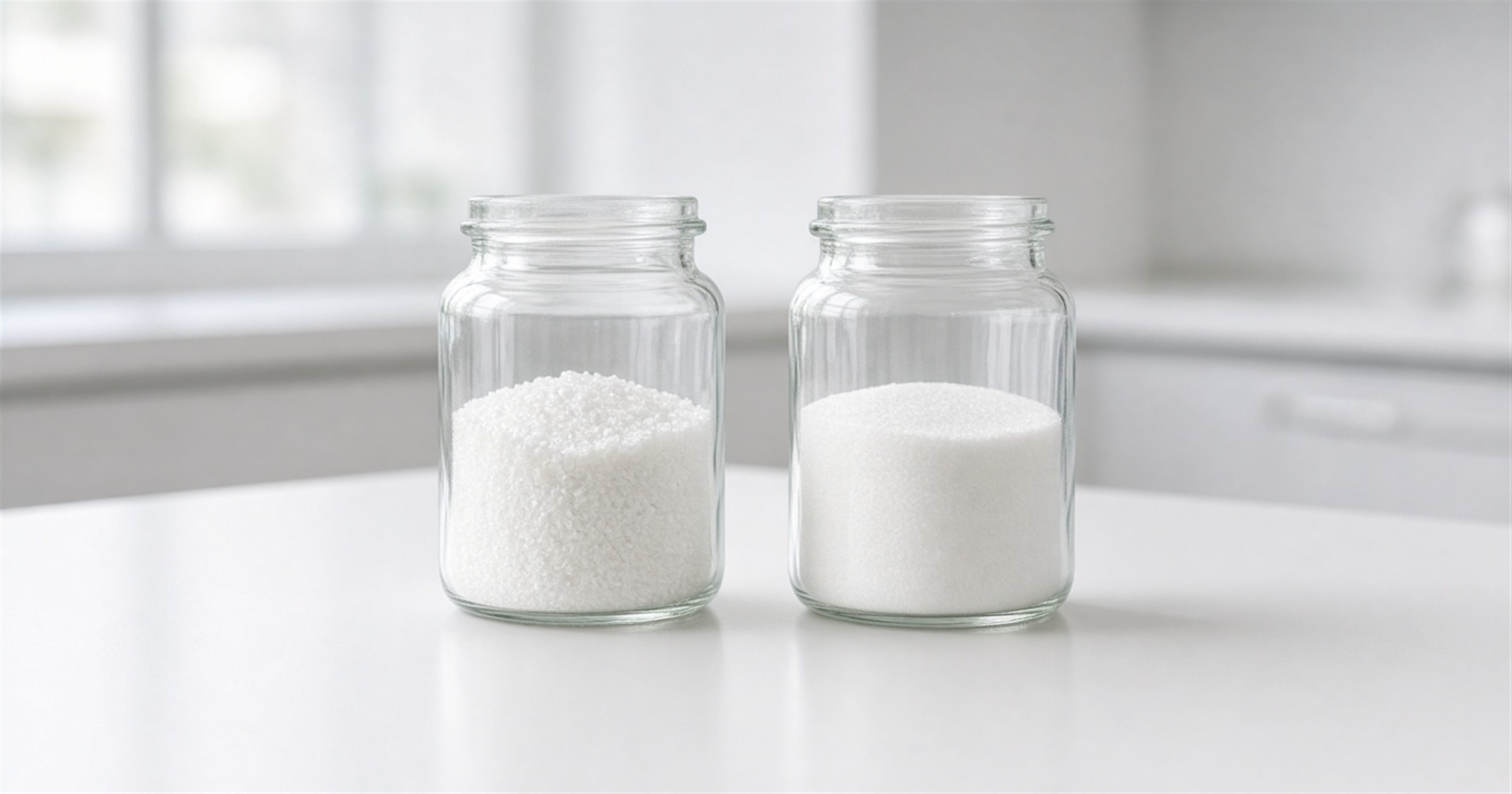
Google Suggest places “trehalose vs ectoine” on the ectoine cluster. That is a two-SKU question. Trehalose is a disaccharide, CAS 99-20-7, formula C12H22O11. Ectoine is the tetrahydropyrimidine solute, CAS 96702-03-3, formula C6H10N2O2. Both can sit in a water phase as white powders. They do not share an INCI, a molecular weight, or a use band.
The powder identity for ectoine, including the eye-drop mix-up, is Ectoine Powder: Lock INCI Ectoin and the 99% Assay. The hyaluronate split is Sodium Hyaluronate and Ectoine: Two Separate Lines.
Two solutes, two documents
| Ectoine on this site | Trehalose on this site | |
|---|---|---|
| INCI to lock | Ectoin | Trehalose |
| CAS | 96702-03-3 | 99-20-7 |
| What it is | Amino-acid-derived compatible solute, MW 142.16 | Disaccharide (mycose), MW 342.30 |
| Form on the page | White crystalline powder, HPLC ≥99% | White crystalline powder, often a dihydrate, assay ≥98% on the specification |
| Suggested use on that page | 0.3–2.0% of the powder; the ectoine page also names up to 5% for a specialized repair brief | 1.0–5.0% |
| Where it goes | Water phase | Water phase, any temperature on that page |
| What “protection” means on the page | A hydration shell around proteins in the marketing description | A vitrified matrix around membranes in the marketing description |
Both pages talk about stress and water. That shared sentence is why the suggest list pairs them. It is not a license to ship one drum against the other INCI. A COA that prints Trehalose cannot close an Ectoin line, even when both assays sit near 99%.
Do not copy the percent across
A 100 kg batch at 2.0% trehalose, as the trehalose page states it, is about 2 kg of that sugar. A 100 kg batch at 2.0% ectoine powder is about 2 kg of the tetrahydropyrimidine, and 2% is the top of the standard ectoine window, not the middle of the trehalose window. A 100 kg batch at 0.5% ectoine is about 500 g. That 0.5% figure is a normal ectoine charge and a low trehalose charge if you meant the sugar.
| If the formula says | And you weigh | What you actually charged |
|---|---|---|
| “2% osmolyte” with no INCI | Ectoine powder | You chose the ectoine window’s top, not a trehalose mid-level |
| “2% osmolyte” with no INCI | Trehalose | You are inside 1–5% for the sugar and you did not add ectoine |
| Both names, one percent | One powder | The second INCI is still missing |
Write both INCIs when the chassis wants both. The trehalose page itself says the sugar can sit next to ectoine. That is two lines on the order, two COAs, and two percents. It is not one “resurrection” powder.
Dihydrate versus anhydrous is a trehalose weighing note. The trehalose specification says the powder is often supplied as a dihydrate. Confirm on that COA whether the percent is as-is or as anhydrous trehalose. Do not paste that dihydrate question onto the ectoine HPLC line. Ectoine on this page is specified as the crystalline solute at 99% or higher, not as a sugar hydrate.
What each one is doing in water
Trehalose is a sugar. It dissolves freely, it is described as stable across heat and pH, and the page positions it as a humectant and cell protectant at 1–5%. Ectoine is not a sugar. It is a zwitterionic solute with its own CAS. The ectoine page positions the powder as a skin-conditioning extremolyte at 0.3–2%, with a separate 5% note for specialized repair. Neither description is a clinical claim you can move from one INCI to the other.
If the brief says only “add the stress-protection powder,” ask which CAS. If it says “trehalose vs ectoine” because a brand sheet used both words, keep both rows until someone deletes one. Silent substitution shows up later as the wrong molecular weight on the INCI list.
Both powders in one kettle
When the formula names both, weigh them as two charges into the same water phase. They do not become one number.
| Batch | Ectoine powder | Trehalose powder | What not to do |
|---|---|---|---|
| 100 kg at 1.0% ectoine and 3.0% trehalose | About 1.0 kg | About 3.0 kg | Do not weigh 4.0 kg of either powder and call it the blend |
| 200 g bench at 0.5% ectoine and 2.0% trehalose | 1.0 g | 4.0 g | Do not split 5.0 g of one jar into “both” |
| A sheet that says only “4% osmolytes” | Unknown | Unknown | Ask which INCI owns which percent before the sample ships |
Dissolve each powder in water. The trehalose page says the sugar can go in at any temperature. The ectoine page says the solute is heat-stable and is often added below 40°C in a cold process. If the kettle is already hot for the emulsion, confirm on each TDS whether that lot still wants the cool-down addition. Do not assume the sugar’s “any temperature” note covers the ectoine drum.
A dihydrate trehalose COA can show a high assay on a dry basis while the scoop still contains water of crystallization. Ask that COA whether 3% means the powder as scooped or anhydrous trehalose. The ectoine line does not have that hydrate question. Its COA is an HPLC assay of the crystalline solute at 99% or higher. Keep the two basis lines in the same email so the warehouse does not “correct” one percent with the other powder’s water content.
What a silent swap looks like on the label
The INCI list is the check after the sample is approved. Ectoin and Trehalose are different names. If the approved bench used both and the production ticket prints only one, the missing name is a missing charge, not a synonym. Molecular weight gives the same warning on the documents: about 142 for ectoine, about 342 for trehalose. A COA that shows 342 on an Ectoin line is the sugar. A COA that shows 142 on a Trehalose line is not the disaccharide.
Do not close the order because both powders are white and both pages mention stress. Match CAS 96702-03-3 to the ectoine drum and CAS 99-20-7 to the trehalose drum, then scale each percent on its own.
What to send for the solute you will weigh
For ectoine:
- INCI Ectoin, CAS 96702-03-3
- Crystalline powder, HPLC 99% or higher
- Percent as supplied, inside 0.3–2% unless you are asking about the 5% note
- COA, SDS, TDS, bench-sample size
If the same project also needs trehalose, add a second block: INCI Trehalose, CAS 99-20-7, dihydrate or anhydrous as the COA states, percent inside 1–5% unless that TDS says otherwise. Do not merge the two blocks into “osmolyte 2%.”
Documents and a sample for the ectoine line are on the Ectoine product page. The sugar has its own Trehalose product page. Match each sample to its CAS, then scale.






