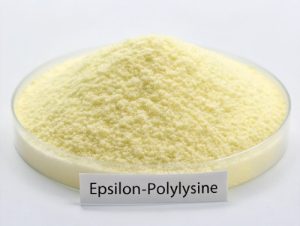
Google Suggest places “epsilon poly l-lysine hydrochloride” next to “epsilon polylysine.” That is a salt question, not a spelling variant. Epsilon-Polylysine on this site is specified as a hygroscopic powder at 98% or higher. A hydrochloride grade can meet a high assay number and still carry chloride. Those are not interchangeable on a COA.
The identity split against culture-coating poly-L-lysine is Epsilon-Polylysine vs Poly-L-Lysine Plate Coating.
Three names, three documents
A brief that says “epsilon poly L-lysine, 98%” still has to choose a column. If the COA prints hydrochloride, the 98% is the salt grade the manufacturer assayed, not proof that you received the free polymer. If the COA prints the free polymer, do not treat residual chloride as optional.
Producer documentation on the ε-polymer notes that the free form is strongly hygroscopic and industrially awkward as a neat 100% powder; liquid cuts and excipient-cut powders exist in the food trade, while many ≥90% powders on the market are hydrochloride. That is a documentation check for the lot in front of you. It is not a claim that every 98% drum on this page is a salt, and it is not a claim that a 50% dextrin grade from another catalog can use this page’s 0.01–0.5% band.
Why the salt changes the kettle sheet
Hydrochloride dissociates in water. Chloride on the COA is a process note for stainless equipment and for any formula that already sits near its electrolyte limit. It is not a reason to reject a lot by email folklore. It is a reason to print “free form” or “hydrochloride” on the sample request so the warehouse does not blend two receipts into one bin.
A 100 kg batch at 0.10% of the 98% powder, as supplied, puts about 100 g of that powder in the kettle. The same 100 kg batch at 0.10% of a 25% liquid puts about 25 g of polymer into the water if the liquid assay is real. Those are not two ways to hit “0.1% epsilon-polylysine.” Write the percent next to the form.
The product page’s 0.01–0.5% window, and the 0.1% booster example, are written for the powder this specification describes. A 25% aqueous grade uses a different multiplier. A 50% powder that is half carrier uses a different multiplier. Copying 0.1% from this page onto a diluted grade under-doses the polymer. Copying 0.1% from a 25% liquid onto this 98% powder over-charges it.
α-Polylysine does not belong in this table as a substitute salt. It is a chemically polymerized coating resin. People Also Ask’s plateng protocol is that material. If the purchase order says poly-L-lysine hydrobromide or poly-L-lysine hydrobromide solution for tissue culture, you are off this product page entirely.
What “natural” does not settle
Fermentation of Streptomyces albulus produces the ε-polymer. A later hydrochlorination step is a salt-forming reaction. Marketing language that says “natural polylysine” does not tell you which column you will receive. Ask the COA for:
- INCI Polyepsilon-Lysine
- Chloride or hydrochloride, reported or “not applicable”
- Appearance: hygroscopic powder versus solution versus carrier blend
Assay method and the basis (as-is, dry, as free polymer)
Do not use a food GRAS notice as the cosmetic specification. Those notices are manufacturer- and process-specific. They do not travel with every powder that shares the trivial name.
What to send for the form you will weigh
For the grade on this site:
- INCI Polyepsilon-Lysine, CAS 28211-04-3
- Powder, 98% or higher, marked as free polymer or as hydrochloride
- Formula percent as supplied, inside 0.01–0.5% unless the TDS says otherwise
- COA, SDS, TDS, and bench-sample size
- A chloride line if your process or packaging is sensitive to it
If the brief truly needs a diluted liquid or a carrier-cut powder, say so in the same message. Do not assume the 98% drum will be concentrated or diluted for you in the plant.
Documents and a sample are on the Epsilon-Polylysine product page. Match the sample to the salt line and the assay, then scale. A request that only says “high purity epsilon polylysine” comes back as a question. A request that names Polyepsilon-Lysine and free form or hydrochloride comes back as a drum you can weigh.