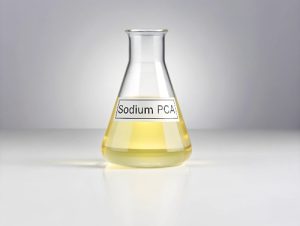
A moisturizer brief that says only “add PCA” is not a sample request. Sodium PCA is the sodium salt of pyrrolidone carboxylic acid, CAS 28874-51-3. On this page it is a colorless to pale yellow clear liquid, typically a 50% aqueous solution, with a dry-basis purity of 99% or higher.
It is not Glycerin. That split is Sodium PCA vs Glycerin: Two Water-Phase Humectants. It is not sodium lactate. That split is Sodium PCA vs Sodium Lactate: Not the Same Humectant. PCA Skin, and other finished lines that use the letters PCA, are brands. They are not this INCI.
What the salt is doing in the water
CosIng lists Sodium PCA as a humectant, a skin-conditioning agent, a hair-conditioning agent, and an antistatic. The product page describes it as a component of the skin’s natural moisturizing factor: it binds water and is chosen when the formula should feel less tacky than a heavy polyol. That is a placement decision. It is not a promise that a lot will repair a barrier or replace the rest of an NMF blend.
“What does it do for the skin?” and “is it safe?” land on the same record. The CIR re-review of PCA and its salts concluded that they are safe in cosmetics in the present practices of use and concentration, and that they should not be used in products where N-nitroso compounds can be formed. In the data behind that review, sodium PCA was the most used salt. Reported concentrations in that survey reached about 2.5% in a leave-on nail product and about 3% in skin cleansing. Those survey figures are not the weighing instruction for this drum. They also are not a reason to call the neat solution “2.5% active” without the COA.
Fifty percent solution and a dry basis are different numbers
The page’s suggested use is 1.0% to 5.0% of the 50% solution. One percent of that solution is about half a percent of the salt. Five percent of the solution is about 2.5% of the salt. The purity line of 99% or higher is the dry basis, not a second promise that the jug is 99% sodium PCA as poured.
| What you weigh | What this page states | How to read 1–5% |
|---|---|---|
| The liquid as supplied | Typically a 50% aqueous solution | The 1–5% band is written for this solution. |
| Active salt on a dry basis | 99% or higher | Ask the TDS before you copy 1–5% onto a dry charge. |
Write on the inquiry which number your formula uses. A kettle sheet that says “Sodium PCA 4%” without “solution” or “active” will be read two ways.
The liquid can go into the water phase at any temperature. The page lists stability from about pH 4 to 9 and says the salt is not sensitive to normal process heat or light. Confirm that window on the TDS. It is freely soluble in water and in ethanol. It is not a wax and not an oil-phase charge.
Hair searches use the same INCI
People also search sodium PCA for hair, in shampoo, and in hair products. The inventory already lists hair conditioning and antistatic beside the humectant function. The powder-or-solution choice does not change because the chassis is a shampoo or a conditioner. Use the same CAS, the same 50% solution unless the COA says otherwise, and the level your TDS allows in that base. A hair search does not create a second specification, and it does not turn the salt into a conditioning quat.
Zinc PCA is the other salt on this site
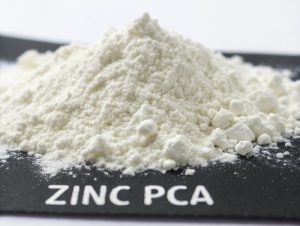
A search for zinc PCA versus sodium PCA is a cation change. Zinc PCA is zinc L-pyroglutamate, CAS 15454-75-8, a white to off-white crystalline powder at 99% or higher. It is water-soluble, and it is not the 50% sodium solution. If the brief names the zinc salt, order that page. If it names Sodium PCA, do not ship the powder because both end in PCA.
The free acid, PCA without the sodium, is a further INCI. This site has no page for it. Do not invent a URL. A line that says only “PCA” still has to choose the acid, the sodium salt, or the zinc salt.
What to send before the first sample ships
Put these lines in the message:
- INCI Sodium PCA, not Glycerin, not sodium lactate, and not Zinc PCA
- CAS 28874-51-3
- Form: 50% aqueous solution, or the dry basis if you truly need the 99% figure, and which one the formula percent uses
- Use window 1–5% only when you are weighing the 50% solution
- Target pH, if you need the 4–9 note confirmed
- Bench-sample size, plus COA, SDS, and TDS
- A note if the chassis is a shampoo or a conditioner, so the sample size matches that trial
Batch documents and a sample are on the product page. Match the COA to the solution strength, then scale. A line that names the 50% solution usually returns documents. A line that says only “PCA for hydration” usually returns a question about which salt.